If your facility has fixed ladders on tanks, silos, rooftops, towers, mezzanines, or process equipment, a “ladder safety system” is not just another safety accessory. It is often the difference between a controlled climb and a fall that turns into a serious injury, fatality, or compliance problem.
Here is the short version: a vertical ladder safety system is an active fall protection system for fixed ladders. It connects a worker’s harness to a cable or rigid rail so the worker can climb with both hands free. If the worker slips, the sleeve or grab locks onto the carrier and arrests the fall.
That definition matters because OSHA is very specific. Under 29 CFR 1910.21, a ladder safety system is designed to eliminate or reduce the possibility of falling from a ladder and usually includes a carrier, safety sleeve, lanyard, connectors, and body harness. OSHA also states that cages and wells are not ladder safety systems.
What Is a Ladder Safety System?
A vertical ladder safety system is a permanently installed fall protection system used on a fixed ladder. It normally includes:
- A carrier, such as a vertical cable or rigid rail, attached to or beside the fixed ladder
- A sleeve, shuttle, or cable grab that travels with the worker
- Connectors or a short lanyard between the sleeve and harness
- A full-body harness, typically connected at the front D-ring
- Mounting brackets, cable guides, rail supports, and end stops
Unlike a ladder cage, a ladder safety system actively connects the climber to the ladder structure. The worker clips in before climbing, moves normally, and stays connected during ascent and descent. If a fall begins, the sleeve locks onto the carrier and quickly limits the fall.
This is why ladder safety systems are common on:
- Telecom and broadcast towers
- Water towers
- Industrial tanks and silos
- Wind turbines
- Smokestacks and chimneys
- Rooftop access ladders
- Process platforms and mezzanines
How Does a Ladder Fall Arrest System Work?
The system is simple in concept, but it has to be engineered and installed correctly.
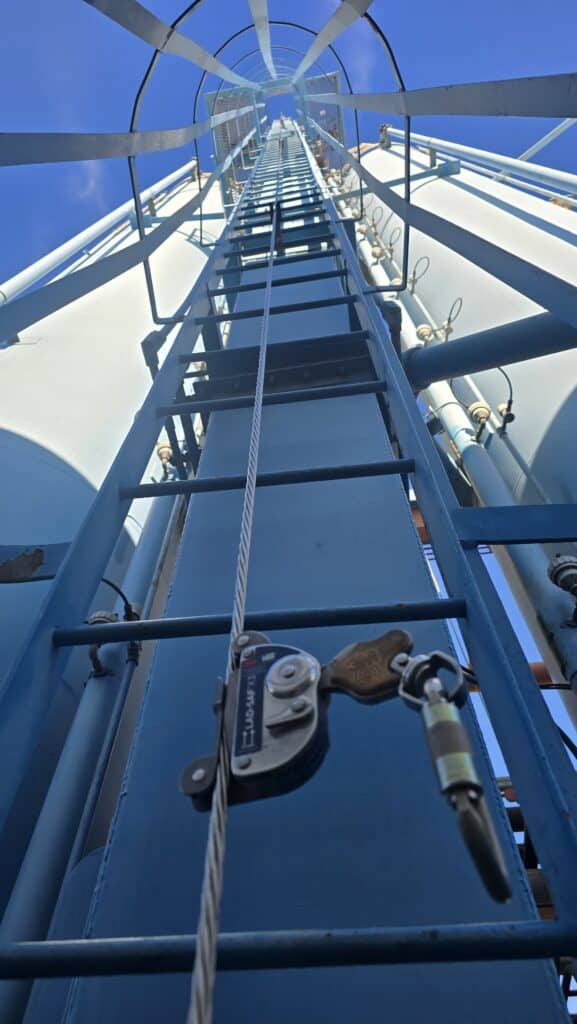
First, a rigid rail or flexible cable is fixed to the ladder. The worker attaches a compatible sleeve to that carrier and connects the sleeve to the front attachment point of their harness. During a normal climb, the sleeve moves freely with the worker. During a sudden downward movement, the sleeve’s brake or cam engages the rail or cable and stops the fall.
OSHA’s criteria for ladder safety systems are found in 29 CFR 1910.29(i). Among other requirements, the system must let the employee climb up and down with both hands, the connection between the carrier or lifeline and harness attachment point cannot exceed 9 inches, and flexible carriers need cable guides installed along the length of the carrier.
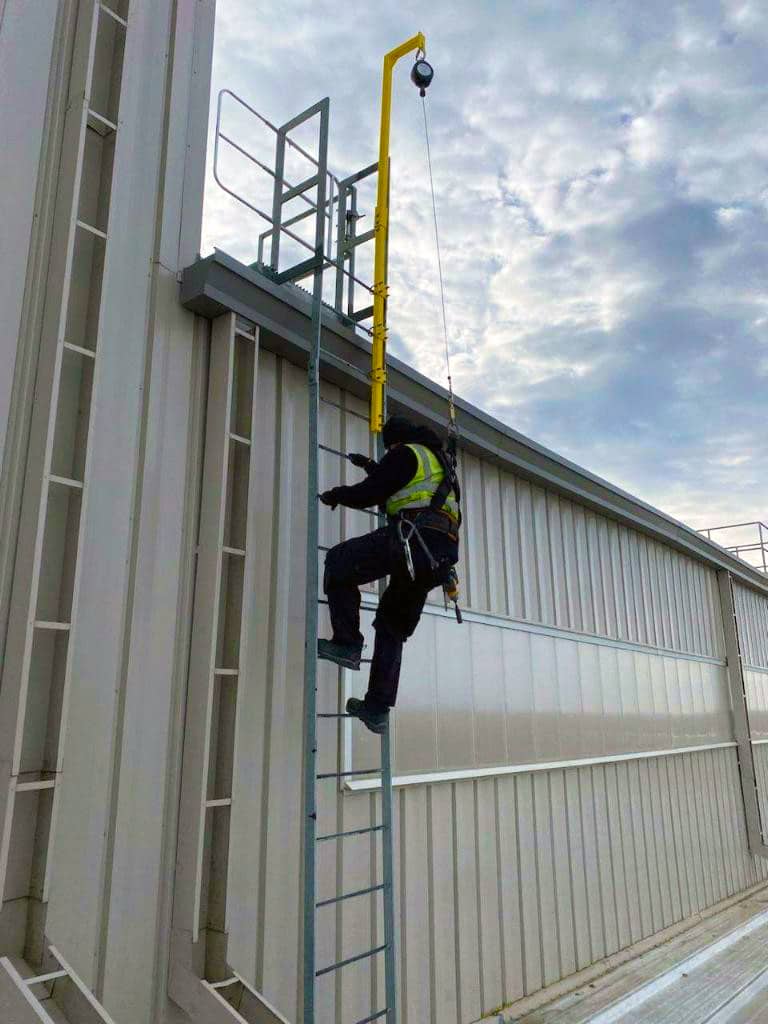
In some applications, a self-retracting lifeline (SRL) may be used as part of a personal fall arrest system instead of a rail or cable-based ladder safety system. An example is a ladder davit anchor, where the worker attaches an overhead SRL to the dorsal (back) D-ring of their harness. That choice depends on the ladder, available anchorage, rescue plan, frequency of use, and whether the system is being evaluated under general industry, construction, or a site-specific standard.
[ME1]Add this sentence to this copy.
Ladder Safety System vs. Ladder Cage
Ladder cages and wells were once treated as the default answer for tall, fixed ladders. They are still found throughout older industrial facilities. But they are not the same thing as a ladder safety system.
A cage surrounds the climbing space. A ladder safety system connects the worker to a carrier and arrests the fall. OSHA’s current definitions make that distinction clear: cages and wells are not ladder safety systems.
That does not mean every existing cage must be removed today. It does mean facility teams should know when a cage is still allowed, when it is not enough, and when a new or replacement ladder section triggers the need for active fall protection.
Current OSHA Rules for Fixed Ladders Over 24 Feet
For general industry fixed ladders that extend more than 24 feet above a lower level, 29 CFR 1910.28(b)(9) is the key rule.
As of May 29, 2026, the current regulation says:
- Existing fixed ladders installed before November 19, 2018 must have a personal fall arrest system, ladder safety system, cage, or well.
- New fixed ladders installed on or after November 19, 2018 must have a personal fall arrest system or ladder safety system.
- When a fixed ladder, cage, well, or section is replaced, a personal fall arrest system or ladder safety system must be installed in at least the replaced section.
- The current rule still contains a November 18, 2036 deadline requiring all fixed ladders to have a personal fall arrest system or ladder safety system.
One important nuance: OSHA has clarified that the analysis is not always limited to the length of one ladder section. If a worker could fall past a platform or lower level more than 24 feet, a ladder safety system or personal fall arrest system may be required even if a particular ladder section is 24 feet or shorter. OSHA explains this in its 2021 fixed ladder interpretation letter.
April 2026 OSHA Update: The 2036 Deadline May Change
This is the update that many older articles now miss.
On April 6, 2026, OSHA published a Notice of Proposed Rulemaking for Walking-Working Surfaces under Docket No. OSHA-2025-0072. The proposal would remove the November 18, 2036 deadline for installing personal fall arrest systems or ladder safety systems on all fixed ladders over 24 feet.
OSHA also summarized the proposal in its April 7, 2026 QuickTakes: the agency proposed removing the deadline, while keeping the requirement that new fixed ladders be equipped with a personal fall arrest system or ladder safety system.
That last point is critical. OSHA is not saying new ladders can go back to cages alone. If the proposal is finalized as written, employers would have more flexibility to keep existing caged ladders in service until the end of their useful life, but new and replacement fixed ladders would still require active fall protection.
Public comments on the proposal are due by June 5, 2026. OSHA may also schedule an informal public hearing if one is requested during the comment period.
What Facility Managers Should Do Now
Do not treat the proposed rule as a free pass, and do not panic-buy retrofits without a ladder inventory. The practical path is more measured:
- Inventory every fixed ladder over 24 feet and note installation date, height, cage/well status, fall distance, and condition.
- Flag any ladder installed on or after November 19, 2018, that does not have a personal fall arrest system or ladder safety system.
- Review replacements and repairs carefully because replacing a ladder section, cage, or well can trigger active fall protection requirements for that section.
- Inspect ladders before use and maintain them as required under 29 CFR 1910.23.
- Train workers on fall hazards, hook-up, tie-off, inspection, storage, and correct use of fall protection equipment under 29 CFR 1910.30.
- Build a rescue plan. A fall arrest system stops the fall; it does not automatically solve suspension trauma, retrieval, or emergency access.
Cable System, Rigid Rail, or SRL: Which Is Best?
There is no universal best system. There is only the best fit for the ladder, environment, frequency of use, and worker task.
A cable-based ladder safety system is often cost-effective for tall fixed ladders and retrofits. It works well where long vertical access is needed and the ladder structure can support the installed system.
A rigid rail system can offer smoother travel and shorter fall arrest distances in many designs. It may be the better choice in heavy-use environments, high-wind areas, corrosive environments, confined vertical spaces, or where the facility wants a more robust engineered solution.
An SRL-based personal fall arrest setup may work where there is a suitable overhead anchorage, and the worker can remain tied off through the climb and transition. It must be designed around the real ladder geometry, fall clearance, rescue access, and manufacturer instructions.
For complex sites, it is worth having a qualified fall-protection specialist review the ladder rather than relying on a product catalog. Companies like HySafe can assess fixed ladders, compare cable, rigid rail, SRL, and custom options, and build a site-specific fall protection plan.
FAQ
Are ladder cages still OSHA compliant?
For general industry, existing fixed ladders installed before November 19, 2018, may still use a cage or well under the current rule, but new fixed ladders over 24 feet must use a personal fall arrest system or ladder safety system. OSHA has proposed removing the 2036 retrofit deadline for existing ladders, but that proposal is not final as of May 29, 2026.
Is the OSHA 2036 ladder cage deadline canceled?
Not yet. OSHA proposed removing the deadline in April 2026, but a proposed rule is not the same as a final rule. Until OSHA finalizes a change, the current regulatory text still includes the November 18, 2036 deadline.
Do fixed ladders under 24 feet need a ladder safety system?
Usually no, if the fall to a lower level is 24 feet or less. But OSHA has clarified that if a worker on a shorter ladder could fall past a platform or lower level more than 24 feet, a personal fall arrest system or ladder safety system may still be required.
Are ladder cages considered ladder safety systems?
No. OSHA’s definition says cages and wells are not ladder safety systems. A ladder safety system usually includes a carrier, safety sleeve, lanyard, connectors, and body harness.
What standards apply to ladder safety systems?
For general industry, start with OSHA 29 CFR 1910.21, 1910.23, 1910.28, 1910.29, 1910.30, and 1910.140. Construction work may fall under 29 CFR 1926.1053, which contains different fixed-ladder provisions. ANSI/ASSP Z359.16 and ANSI ASC A14.3 may also be relevant consensus standards for climbing-ladder fall-arrest systems and fixed-ladder design.
What else is changing besides OSHA?
The main live regulatory development is OSHA’s 2026 proposed rule on the 2036 deadline. On the consensus standards side, ANSI’s Proposed American National Standards list reported BSR A14.3-202x, a revision of ANSI A14.3 for fixed ladders, with public review completed as of May 2026. Facility teams should monitor ANSI/ALI updates, but OSHA compliance should be based on the applicable OSHA standard and any final rulemaking.